




Imagine a school where students don’t just sit through lessons but actively engage with their environment, solving problems, exploring creativity, and developing essential life skills through play. What if you could maximize learning outcomes simply by encouraging unstructured play in your classrooms and outdoor spaces? The truth is unstructured play isn’t just social fun. It’s actually a powerful classroom tool and strategy for cognitive, social, and emotional development.
Yet, many schools overlook its full potential, and even fewer prioritize inclusive play strategies that allow every child, regardless of ability, to reap the benefits. If you're not leveraging unstructured play in your school, you may be missing out on one of the most effective ways to foster early learning, resilience, and collaboration among students. Keep reading to discover why unstructured play is essential, how it benefits all learners, and practical ways to create more inclusive play opportunities in your school.
Get ready to rethink playtime. It’s more important than you think!
Why unstructured and imaginative play matters
Imaginative play serves as an incredible tool for encouraging and shaping a child’s development. However, for children with disabilities, unstructured, imaginative play may not be as accessible as it is to their typically developing peers. Organic learning through play is an important tool in the classroom for educators and child development professionals. Opportunities to learn while moving and integrating information kinesthetically maximize learning, incorporate socialization and emotional regulation skills, and keep kids engaged throughout the day.
Did you know? Lev Vygotsky’s learning through play theory suggests early learners develop their social skills, oral language, and communication skills through unstructured learning interactions.
Inclusive materials and construction appear in various forms and combinations. An inclusive swing set can include an adaptive swing, a climbing wall can include adaptive grips and angles, and play toys can have practical, ergonomic designs to foster social and motor skills.
Inclusive play strategies bridge the gap between the typically developing child and one with disabilities, and physical or sensory barriers require creative environmental adaptations to be fully inclusive. Adaptable play solutions like The Primary System 2 help create a universal design for play equipment that accommodates those with disabilities while remaining engaging for those without disabilities.
Research also suggests that traditional learning promotes “surface learning,” but the true growth comes when your students can experience “deeper learning.”
Surface learning: Represents the ability to memorize and retain key principles and facts.
Deeper learning: Represents the ability to connect factual knowledge directly to real-world experiences, better grasping their implications and effects.
5 Characteristics of play-based learning
Play-based learning is rooted in key characteristics that make it a powerful educational tool. These five traits help define how play supports cognitive, social, and emotional development in young learners:
Socially interactive: Play-based learning thrives on collaboration, helping young students build communication skills and navigate social relationships.
Iterative: Through trial and error, children refine their ideas, learning resilience and problem-solving in a natural way.
Actively engaging: Hands-on, immersive play keeps students focused and invested in the learning process.
Joyful: A sense of fun and excitement makes learning enjoyable, reducing stress and boosting motivation.
Meaningful: Play connects learning to real-life experiences, making concepts more memorable and relevant to young learners.
The benefits of unstructured play
Unstructured play is beneficial inside and outside the classroom and is a modality experts praise as vital to information consumption, processing, and learning. It allows young minds to integrate information uniquely and meaningfully, supporting neural connections to form cognitive associations between movements and concepts, even after a designated lesson time.
As young students grow and explore unstructured play, their minds constantly evaluate and assess successful and unsuccessful outcomes. They learn to apply concepts in a trial-and-error approach to other scenarios, which translates directly to confidence and effort in learning.
Novel activities develop language, thinking, problem-solving, and motor skills. By interacting with others, early learners learn socio-emotional skills, cooperative behaviors, and even conflict resolution. Imaginative play, especially with appropriate challenges, develops resilience and decision-making.
Children develop resilience under failure, too. A failure scenario can look like a child attempting a climbing wall and falling. As the child recovers, reattempts, and succeeds, resilience takes hold and leads to perseverance, which translates to resilience and perseverance in any task, especially learning.
Did you know? The Journal of Pediatrics reported strong evidence that unstructured play, or play without adult or peer intervention, can better support children’s socioemotional and mental health.
Your students with disabilities who aren’t around an inclusive environment have a unique need in this regard–resilience is more difficult to come by organically. Resilience is perhaps an even more important skill to nurture in children with disabilities, and inclusive environments play a key role.
For perspective, preschool and grade school students with specific learning disability (SLD) have a high risk of low resilience. Severe stress, depression, and anxiety are also present. Children of all abilities need to develop the ability to learn successfully in order to maximize their success as adults.
Examples for teachers in the classroom
Set up a "free play" station with building blocks, art supplies, or puzzles to encourage creativity and problem-solving.
Designate a portion of recess or class time for open-ended exploration where students choose their own activities.
Key benefits:
Enhances Cognitive Development – Helps students form neural connections through movement and exploration.
Encourages Problem-Solving – Kids use trial and error to build confidence and learning strategies.
Develops Social and Emotional Skills – Interaction with peers fosters cooperation, empathy, and conflict resolution.
Builds Resilience – Overcoming failure in play leads to perseverance in academic and personal tasks.
Supports Inclusive Learning – Children with disabilities benefit from environments that nurture resilience and social skills.
Indoor vs. outdoor play: Finding the right balance
While play in any capacity is wonderful for young, developing minds, encouraging imaginative play in indoor and outdoor areas presents an opportunity to curate designated spaces. First, it helps to understand how educators can maximize skill acquisition with these spaces.
Indoor play naturally encourages a quieter style of play and exploration for preschool and elementary children and typically focuses on developing fine motor skills and sensory exploration. Exploration in a quiet environment helps early learners who are averse to larger, noisier environments while at the same time encouraging a slower, quieter pace with their peers. In contrast, indoor play also fosters self-regulation skills in those who thrive in busy, loud environments and helps your young students learn how to regulate themselves around others in close quarters.
Indoor play benefits:
Encourages fine motor skills and sensory exploration.
Provides a quieter, structured space for self-regulation.
Helps children adjust to different levels of social interaction.
Outdoor play encourages gross motor skills, rough-and-tumble interactions, play with large objects, cooperation, strategy, and even strength and endurance training. There’s a higher level of inherent risk in outdoor play, which means your young students also learn the cause and effect and natural consequences of certain risks and learn to develop their problem-solving and decision-making skills even further.
Outdoor play benefits:
Promotes gross motor skills, endurance, and physical coordination.
Encourages cooperative and strategic play.
Introduces controlled risk-taking, helping children understand cause and effect.
Indoor and outdoor play can encourage different skills, depending on the environment. Both are important in a child’s development. Loose parts play systems have a particular advantage in this situation. Loose parts systems comprehensively develop a continuity between spaces, environments, and unstructured play.
Educational spaces can seamlessly bridge indoor and outdoor play with intentional and thoughtful product integration. The Primary System 2 is just that solution. It has many coordinating pieces and structures that can help the transition between indoor and outdoor play and, in turn, develop skill translation to a deeper degree.
Further reading: Don’t overlook the power of outdoor learning and explore these top furnishings for outdoor play right now.
The Primary System 2
The Primary System 2, also known as the Snug Play Primary System, is an introductory loose-parts play system designed to foster creativity, collaboration, and physical activity among early learners. This system includes a variety of modular components made from durable materials with both hard and soft textures, allowing children to construct and reconfigure play structures in numerous ways. By engaging with these pieces, your students can enhance their spatial awareness, problem-solving abilities, and social interaction skills. The Primary System 2 is particularly suitable for smaller daycare centers or educational settings looking to incorporate flexible and imaginative play opportunities.
Did you know? ScienceDirect suggests that free play can predict self-regulation years later, citing longitudinal studies and evidence spanning a large sample of toddlers and preschoolers in Australia.
Play-based learning ideas & benefits
Play-based learning has so many unique benefits; the joy lies in seeing young learners reap such benefits. Different types of play help to develop different skills, and inclusive environments hold an immeasurable potential for classrooms and children of all abilities to maximize their skills and grow into wonderful learners.
Examples for teachers in the classroom
Allow students to use loose parts like cardboard, fabric, and recycled materials to create their own projects.
Introduce "imagination breaks" where students can tell stories, role-play, or engage in spontaneous games.
Organize a weekly "maker space" session where students can tinker, build, and experiment with various materials.
Encourage outdoor exploration by setting up nature scavenger hunts or free-play zones with simple items like sticks, rocks, and chalk.
Let students design their own games and rules, fostering creativity and teamwork while giving them ownership of their playtime.
Types of play-based learning:
STEM & Engineering Play – Encourages fine motor skills, problem-solving, and scientific inquiry through blocks, scales, and building activities.
Sensory Play – Supports self-regulation, texture resilience, and novel exploration with sensory tables and adaptable learning tools.
Pretend Play & Storytelling – Fosters cognitive skills and language development using props, playhouses, and role-playing activities.
Obstacle Courses – Boosts movement-based learning and gross motor skill development with foam constructions and climbing elements.
STEM and engineering play isolates fine motor skill development, advanced problem-solving skills, and cause-and-effect learning. Blocks, towers, scales, science tables, and more help encourage young students to ask questions, explore the “what-ifs,” and let their inner scientists shine. Instilling wonder and enthusiasm for science is critical for future well-informed adults who can think critically and effectively apply their skills throughout life.
Sensory play can be a tool for teaching self-regulation skills, building up resilience to unique textures, and making novel exploration exciting. Sensory tables, corners, or smaller sensory toys benefit early learners of all ability levels. Creating adaptable spaces for diverse sensory needs can lead to many positive interactions and outcomes within a communal environment.
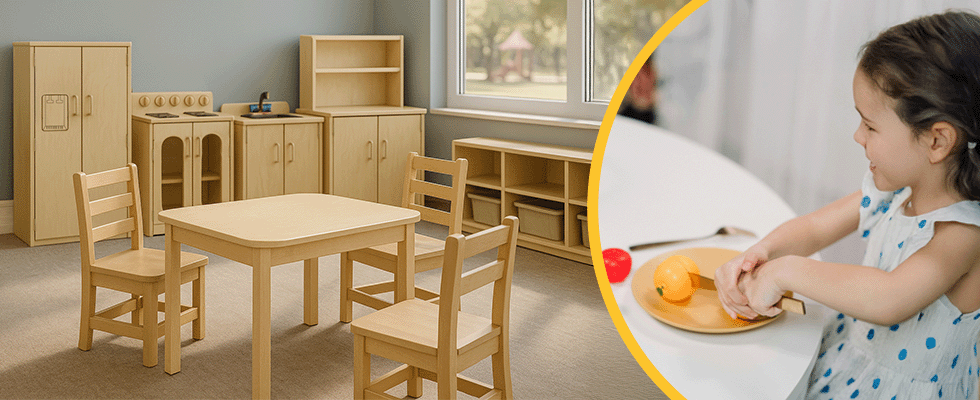
Pretend play and storytelling are hallmarks of imaginative play. Cognitive skills are at their peak with imagination and role-playing and interactive storytelling are incredible ways to foster language development. Props, playhouses, and even pretend kitchens are lovely additions to learning spaces, and bonus points go to those that include working hardware, cabinets, or faucet handles.
Obstacle courses are one of the best ways to encourage movement and gross motor skill development. Soft foam constructions are a safe inclusion in play areas for younger students, and as they grow older and bolder, outdoor equipment is considered an appropriate step up.
According to experts at the Center for Universal Education, “Content isn’t learnable if [a student’s] communication skills aren’t in place.” With learning through play, students can learn more effectively when new information connects to what they already know. In a way, this type of play encourages young learners to build new skills on top of their existing skills.
Inclusive play strategies
Inclusive play ensures accessibility for your students of all abilities. These needs can range from sensory regulation difficulties to physical disabilities. Educators and childcare professionals have a special role in these early years. Adding inclusive elements that allow children of any ability to interact, explore, play, and develop their own skills establishes a foundation for success as adults.
Examples for teachers in the classroom
Provide adaptive play materials such as textured toys, sensory bins, and modified seating for students with different needs.
Encourage peer collaboration by pairing students for cooperative play experiences that include everyone.
Strategies for inclusive play:
Universal Design – Incorporate features like adaptive play structures, multi-level engagement, and accessible pathways.
Social Integration – Encourage peer collaboration through shared play experiences.
Sensory Processing Support – Include sensory-friendly areas to accommodate diverse needs.
Confidence Building – Offer open-ended play opportunities to empower students of all abilities.
Universal design is a concept based on integrating products or designs that are seamlessly usable by the typically abled but intentionally inclusive for the differently abled. An example of this is automatic sliding doors. They’re inconspicuously included in most grocery stores and allow ambulatory, non-ambulatory, wheelchair users or the visually impaired to access the building at the same level.
Social integration, sensory processing support, and confidence-building are only the tip of the iceberg of inclusive play benefits. The Primary System 2 comprehensively supports inclusive play through multi-level engagement, open-ended design, and opportunity for peer collaboration at every turn.
Practical implementation for educators & childcare providers
Educators and childcare providers can seamlessly integrate elements of unstructured play and inclusion in their learning spaces. Loose-part play allows curriculums to easily use and reuse elements to lower costs and adhere to classroom budgets. Cross-curricular learning is an additional benefit.
Implementation tips:
Use loose-part play elements for budget-friendly, adaptable learning tools.
Design play areas with varied heights, adaptive materials, and multi-sensory elements.
Collaborate with occupational and physical therapists to support your students with specific needs.
Encourage independent play initiation to maximize creativity and learning potential.
Designing inclusive play environments can be as simple as varying play heights from floor to table, using adaptive materials, handles, or tools, and including toys or tables that encourage multi-sensory engagement. It’s also helpful to utilize the knowledge and input of your program’s resident occupational or physical therapists if they’re available. These developmental professionals can lend key insights into specific student needs, especially if they’re on caseload.
Ultimately, the best practice for encouraging unstructured play is to allow for independent initiation, self-direction, and access to diverse materials. Reducing structured activities allows for imagination to soar, and it’s often surprising to witness what young learners create with space for creativity to flow.
School furniture that supports unstructured play
Create an environment that fosters unstructured play and start with the right classroom furniture and materials. Schools can design flexible, engaging spaces that encourage movement, creativity, and collaboration. Whether indoors or outdoors, having the right school furniture ensures your young students can freely explore, interact, and learn in an open-ended way.
Here are 10 of the many furnishings from School Outfitters that support unstructured play in various settings.
Modular Soft Seating – Allows students to rearrange and create their own seating configurations for collaborative or independent play.
Mobile STEM Maker Stations – Provides a hands-on workspace for tinkering, experimenting, and building.
Adjustable Standing Desks – Encourages movement and flexibility in the classroom, promoting active engagement.
Outdoor Learning Tables – Durable, weather-resistant tables that allow for open-ended activities outside.
Sensory Activity Panels – Ideal for inclusive learning environments, offering tactile and interactive play opportunities.
Loose Parts Play Kits – Includes open-ended materials like wooden blocks, fabric pieces, and connectors to encourage creative construction.
Balance and Climbing Structures – Supports gross motor development and exploratory movement in both indoor and outdoor play areas.
Cozy Reading Nooks – Provides a comfortable retreat where students can engage in imaginative play and storytelling.
Portable Puppet Theaters – Encourages role-play and creativity through storytelling and dramatic play.
Rolling Whiteboards & Chalkboards – Allows students to brainstorm, draw, and create freely, supporting both structured and unstructured learning moments.
By incorporating these furnishings, schools can create dynamic play spaces that encourage problem-solving, social interaction, and independent exploration—ensuring students benefit from the full potential of unstructured play.
School Outfitters can support all your unstructured and imaginative play efforts
Unstructured and inclusive play plays a crucial role in every classroom and learning space. Children thrive in opportunities for play, regardless of ability. Imagination encourages cognitive skills, language development, gross and fine motor skills, and more, which leads to better learning overall. The skill of learning lies in resilience, and resilience develops slowly through natural experiences during play.
Further reading: Experiential learning and its benefits in K-12 classrooms to see how experiential learning and hands-on activities can boost student engagement, retention, and outcomes.
The foundation of a brilliant learner lies within the formative years of development. Play-based learning leads to great outcomes in early learners across the board. And creating an inclusive environment extends that reach further to children who may not have the same opportunity outside of the classroom.
Adaptable solutions like the Primary System 2 are a seamless way to incorporate play-based learning into a space. Systems that prioritize loose-parts play to encourage creativity by reducing an item's imaginative boundaries. A sphere can easily be a bowling ball, a crystal ball, or a precious artifact that a young geologist is waiting to discover. These systems also help bridge the gap between indoor and outdoor play and play-based learning across whole curriculums. And as you encourage your young students to imagine and explore, know that School Outfitters is here to help you create those impactful spaces.
Find all the classroom play, outdoor systems, and imagination station furnishings right here. Start browsing today, and be sure to check out the furnishings available for quick ship. When you’re ready to create thoughtful learning environments for your preschool and elementary school students, contact us! We make getting a quote fast and easy. And we’ll make sure you get what you need on time and on budget.