




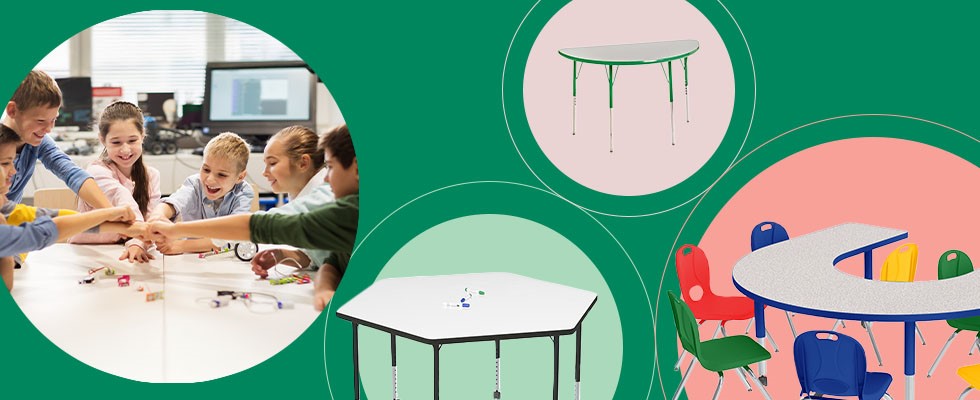
Half circle, U-shaped & hexagon tables: which shape is right for your classroom?
Walk into your classroom during a small group block, and you can feel it right away. A few students are trying to focus, someone’s twisting in their seat to see you, and you’re leaning across a table just to reach a worksheet or make eye contact.
It’s not that the lesson isn’t working. It’s the setup. And how you arrange your classroom furniture, especially the tables, can make a big difference.
The right table shape changes everything about how that moment feels and flows. A half-circle table brings students in closer and keeps everyone facing forward. A U-shaped table creates a space where you’re right in the middle of the action, able to guide, support, and adjust in real time. And for collaborative moments, shapes like hexagon tables open things up in a completely different way.
If you’ve been piecing together small group spaces with whatever fits, this is where things start to click. The right table doesn’t just fill space. It supports how you teach, how your students engage, and how smoothly your day runs.
You can explore a full range of colorful options in the Activity Tables to see how these shapes come to life across different classrooms.
Why table shape matters in the classroom
It’s easy to think a table is just a table until you see what happens when the shape actually works with you.
Table geometry influences everything, including where you sit. How easily can you reach a student? Whether students are looking at you, at each other, or somewhere off to the side. Those small details add up fast.
With traditional rectangular tables, there’s often a subtle disconnect. Students sit across from each other, attention drifts sideways, and you’re constantly adjusting your position to stay connected. It works, but it takes effort.
Specialty shapes are designed to remove that friction.
They pull students into your line of sight. They bring materials within reach. They create a natural focal point, so your instruction feels more direct and less scattered. Instead of managing the setup, you’re able to stay in the moment with your students. Yes, the right school furniture can help you create this ideal learning environment.
There’s also a practical side to it. The way a table fits into your room affects traffic flow, storage, and how easily you can reconfigure your space. A thoughtful shape can open up your classroom without adding complexity.
If you’re looking to build a space that supports movement and interaction, it helps to think about how table shapes play into flexible layouts, like those explored in How Teachers Can Increase Classroom Collaboration.
Half-circle tables: Accessible, flexible, small-group ready
There’s a reason the half-circle table for classroom setups shows up again and again in small group spaces. They just work.
Picture sitting at the flat edge while your students arc around the curve. Everyone is facing you. Everyone is within reach. No one is twisting around to stay engaged. It’s a simple shift, but it changes how connected the group feels.
This shape naturally supports reading groups, guided math, and intervention work where proximity matters. You can see every paper, hear every response, and step in without breaking the flow of the lesson.
For classrooms working with tighter layouts or younger students, a small half-circle table can make the same impact without taking over the room. It keeps the group close and manageable while still creating that clear instructional focus.
Another advantage is the open center space. Materials, manipulatives, and books stay accessible without cluttering individual work areas. That means less time passing things around and more time actually using them.
You’ll find a range of these options within Round Classroom Tables, making it easy to match size and height to your specific classroom setup.
U-shaped (horseshoe) tables: Maximum reach, ideal for direct instruction
If the half-circle table brings students closer, the U-shaped table for classroom setup takes it one step further. It puts you right in the center of everything.
With a U-shaped table classroom layout, you’re not reaching across or leaning in. You’re inside the curve, moving easily from student to student. That kind of access changes how instruction feels, especially during moments that require more support or attention.
This setup is especially powerful for:
Targeted reading instruction
Test prep and skill reinforcement
Socratic-style discussions
Small groups with differentiated or IEP-driven support
You can see what each student is doing without interruption. You can step in quickly when someone needs help. And because students are arranged around you, attention naturally stays focused on the center of the group.
Compared to a half circle, U-shaped tables typically accommodate more students while still maintaining that close, connected dynamic. It feels structured without being restrictive, which makes it a strong fit for classrooms balancing multiple needs at once.
If you’re looking to build a small group space that gives you full visibility and control without feeling rigid, exploring U-Shaped Tables can help you find the right configuration.
Hexagon tables: Collaborative, group-oriented, space-efficient
Now shift the focus from teacher-led to student-driven.
Hexagon tables bring a different kind of energy into the room. Instead of everyone facing one direction, students sit around multiple sides, naturally turning toward each other. That simple change invites conversation, collaboration, and shared problem-solving.
Hexagon tables for classroom environments are a great fit for:
STEM activities
Project-based learning
Group discussions
Centers that rotate throughout the day
They also work well in classrooms that need flexibility. You can keep them as individual workstations or group them together to create larger collaborative zones. That adaptability makes them a strong option for spaces that are constantly shifting.
While they don’t center the teacher in the same way as half-circle or U-shaped tables, that’s the point. They create space for students to engage with each other, which is just as important in a well-rounded classroom.
You can explore different configurations and sizes through Hexagon Tables to see how they might fit into your layout.
How to choose: Side-by-side comparison
When you’re looking at all three shapes together, the decision starts to feel a lot clearer. Here’s a simple way to think about it.
Half-Circle Table
Great for small group instruction where you want students focused directly on you. Works especially well in K–8 settings and tighter spaces. It shifts small group time from slightly scattered to naturally focused. Students face in, attention lands faster, and you’re not constantly repositioning to stay connected. It creates a quieter, more controlled space where you can actually work through instruction without competing for attention.
U-Shaped / Horseshoe Table
Ideal when you need full access to every student. Strong choice for direct instruction, intervention, and groups that benefit from close support. It turns small group instruction into something you can fully manage in real time. You’re already within reach of every student, which means less redirecting, fewer interruptions, and more in-the-moment support. Everything feels tighter, more intentional, and easier to keep moving.
Hexagon Tables
Best for collaborative work and peer interaction. A go-to for STEM, projects, and flexible classroom setups. It moves the energy from teacher-led to student-driven. Instead of waiting to be called on, students naturally engage with each other, share ideas, and problem-solve together. The space feels more active, more collaborative, and a lot more flexible.
There are also a few practical details worth keeping in mind. Height-adjustable options make it easier to support multiple grade levels or shared spaces. ADA-accessible configurations ensure every student can participate comfortably. And thinking about how tables pair with seating can make a big difference in your students' overall comfort and table usability.
If you’re building a full setup, pairing your tables with options from Classroom Chairs helps create a cohesive and functional learning space.
For more ideas on how layout impacts engagement, strategies like those shared by Edutopia highlight how small adjustments can make a big difference in how students interact and stay focused.
Frequently asked questions about classroom table shapes
What is the difference between a U-shaped table and a horseshoe table?
They’re essentially the same concept. Both create a curved or open-ended shape that allows the teacher to sit or stand inside the table, giving direct access to every student.
What size half-circle table do I need for my classroom?
It depends on your group size and available space. Smaller versions work well for early grades or tighter rooms, while larger options can support more students without losing that close instructional feel.
Can hexagon tables be pushed together for larger groups?
Yes, and that’s one of their biggest advantages. Multiple hexagon tables can be grouped to create larger collaborative workspaces or separated for individual group activities.
Are these tables height-adjustable?
Many classroom tables offer adjustable height options, making it easier to accommodate different grade levels or evolving classroom needs.
What’s the best classroom table shape for small reading groups?
Half-circle and U-shaped tables are both strong choices. Half-circle tables keep groups tight and focused, while U-shaped tables provide more space and direct access for the teacher.
Find the Table That Fits the Way You Teach
The right table shape doesn’t just change how your classroom looks. It changes how it feels to teach and learn in that space.
When students are positioned where they can see, reach, and engage more easily, everything starts to flow better. Instructions land faster. Transitions feel smoother. Small group time becomes something you look forward to instead of something you have to manage.
Whether you’re building out a new classroom or rethinking your current setup, you’ve got options that actually support the way you work.
Explore the full selection of Activity Tables or dive deeper with the Activity Table Buying Guide to find the shape that brings your classroom together in a way that just makes sense. And if you need help ordering tables for your school, just connect with our team for design ideas, product info, warranty questions, and ordering. We’ll make every step Experience Positive.

Ready for the next step?
Talk to a School Outfitters furniture expert today and get assistance on everything from product selection and room designs to purchase compliance and delivery.