




Student mental health is no longer a peripheral concern in school design. It is central to it. Post-pandemic social disruption, rising rates of anxiety and depression among youth, and the increasing complexity of adolescent life have all pushed mental health support to the top of the priority list for administrators and facility planners alike.
The question educators and designers are now asking is not simply how schools respond to mental health crises, but how the physical environment can work proactively to support students before those crises occur.
What follows is a breakdown of four core student mental health needs and the space strategies that address each one, along with practical guidance on how furniture and design choices bring those strategies to life.
What are the current mental health challenges in schools?
Rates of anxiety and depression among children and adolescents have risen sharply over the past decade, with the pandemic accelerating trends that were already underway. According to the CDC, nearly 1 in 5 children ages 3 to 17 has a diagnosed mental, emotional, developmental, or behavioral disorder. For school administrators, that statistic is not abstract. It shows up every day in classrooms, hallways, and counseling offices.
Schools are being asked to do more than ever: deliver instruction, provide social-emotional support, and create environments where all students feel safe enough to learn. That last part, the environment itself, is where space design enters the picture.
The physical spaces schools create send a message to students about whether their emotional lives matter. When that message is intentional, it can meaningfully reduce stress, increase connection, and build the kind of resilience that supports long-term academic success.
What student needs should school space design address?
Research and practice point to four broad categories of student mental health need, each with direct implications for how schools are designed and furnished.
1. Immediate needs: what spaces help students during acute distress?
When a student experiences a breakdown or emotional crisis, the school's first priority is to help them decompress without fully removing them from the learning environment. The right spaces make that possible.
Breakout rooms adjacent to classrooms give students a place to step away briefly and return with minimal disruption to instruction. These do not need to be large or elaborate. A small, calm space with soft seating and low stimulation can serve the purpose well.
Outdoor benches in close proximity to the building offer fresh air and a change of sensory input without requiring a student to leave the campus. Proximity matters here: the closer the bench is to the classroom, the lower the barrier to use.
Storage for sensory regulation tools, including fidget tools, weighted blankets, and squeeze balls, is also part of the equation. These tools, when used as part of an individualized, occupational therapy-informed plan, can support self-regulation during moments of acute stress. Accessible, organized storage makes them available when they are actually needed. Aromatherapy options such as peppermint essential oil sprays are similarly worth keeping on hand for students whose plans include sensory-based calming strategies.
2. Emotional regulation: what spaces help students build self-regulation capacity?
Beyond crisis response, many students need structured support for developing their own emotional regulation skills over time. Space design plays a meaningful role in whether students actually use those skills.
Tranquility spaces and zen dens are dedicated areas within or adjacent to classrooms designed for calm, sensory-reduced experiences. They typically feature soft seating, muted tones, and reduced visual clutter. When these spaces exist and are normalized within the school culture, students are more likely to use them proactively, before a situation escalates.
Regulation stations are a more classroom-integrated version of the same idea: a small, semi-private area within a room where a student can step back from the group and practice self-regulation without leaving the space entirely. Research supports the value of this kind of in-room option. A student who can regulate in place is far more likely to re-engage with instruction than one who has been sent out of the room.
Circle time areas for younger learners serve a related purpose. Group rituals built around emotional check-ins, common in early childhood settings, build emotional awareness and social connection as daily habits, not just crisis responses.
Counseling and intervention spaces round out this category: nurse's stations, private counseling rooms, and flexible areas where outside counselors can meet with students. These spaces need to feel welcoming and private, not clinical or punitive, to reduce the stigma around seeking support.
From the field: When one School Outfitters client, a mid-size Midwestern district, added regulation stations to its elementary classrooms during a renovation, teachers reported that students began using them voluntarily within the first week. The stations were stocked with sensory tools selected in coordination with the district's occupational therapy team and positioned near but distinct from the main instructional area. The result was fewer classroom disruptions and more students returning to focused work after short breaks.
3. Socialization: what spaces help students build real connections?
One of the more urgent concerns in current youth mental health research is the collapse of in-person socialization, particularly among students who came of age during the pandemic. Research published in JAMA Pediatrics found significant increases in loneliness and social withdrawal among adolescents during and after pandemic school closures, effects that persist for many students today.
Schools are now being asked to create environments that actively facilitate connection, not just permit it. That is a design challenge as much as a programmatic one.
Informal gathering spaces and common areas are foundational. When hallways, lobbies, and shared spaces are furnished to invite lingering and conversation, with comfortable seating, varied configurations, and a sense of ownership, students use them that way.
Dining areas designed as social hubs, not just cafeterias, make a meaningful difference. Furniture arrangement, acoustic treatment, and the overall feel of a dining space all influence whether students experience it as a place they want to be.
Outdoor benches and tables extend this into the natural environment. Students who have access to comfortable outdoor gathering spaces use them, and the physical and psychological benefits of time outdoors reinforce the social ones.
Athletic facilities and club spaces, including media centers repurposed for student organizations, give students a sense of belonging through shared activity. Belonging, in the research literature on adolescent mental health, is one of the strongest protective factors against depression and anxiety.
Student centers that function as drop-in spaces for informal support, cohort meetings, or discussions around topics like grief and stress normalize help-seeking behavior. When the space exists and feels safe, students are more likely to use it.
Project-based learning areas foster peer relationships as a natural byproduct of the work itself. Collaboration built into the curriculum is one of the most efficient ways to support socialization among students who might otherwise struggle to connect.
4. Self-efficacy: what spaces help students build confidence and independence?
Students who feel capable and agentic are more resilient. Research on self-efficacy in adolescents consistently shows that students who believe they can affect outcomes in their lives are better equipped to manage stress and setbacks. Space design can actively support that development.
CTE spaces and makerspaces give students opportunities to build tangible skills and see the results of their own effort. The connection between making something real and feeling capable is direct and powerful.
Art and music spaces support creative expression and identity formation, both of which are closely tied to mental health and resilience in adolescence.
Spaces for peer tutoring and mentoring benefit both the student receiving support and the one providing it. The student who tutors a peer gains confidence and a sense of purpose that academic instruction alone rarely produces.
Experiential learning environments, including outdoor STEM areas, digital studio spaces, video and AV labs, and computer labs, connect learning to the real world in ways that build genuine competence. These are not enrichment extras; for many students, they are the spaces where school finally feels relevant.
Breakout spaces in media centers that simulate professional environments support internship and work-based learning programs, giving older students a concrete bridge between school and the autonomy they are working toward.
What is biophilic design, and why does it matter for student mental health?
Biophilic design is the intentional integration of natural elements into physical spaces to improve wellbeing. A study published in MDPI's Psychiatry International found that school environments incorporating natural light, natural materials, and views of nature had measurable positive effects on student and staff wellbeing, with 100% of stakeholders in the study agreeing that access to sunlight and natural views improves outcomes.
The good news is that biophilic design does not require a complete facility overhaul. Schools can introduce nature connection across a wide range of interventions, from significant to modest.
Outdoor spaces:
Playgrounds, outdoor garden areas, and outdoor dining spaces
Outdoor STEM equipment and learning areas
Benches and tables positioned to encourage outdoor gathering
Indoor spaces:
Indoor hydroponics, planters, and living garden walls
Natural wood furniture, which the MDPI research identifies as one of the most affordable and high-impact biophilic interventions available to schools
Biophilic color choices and patterns that evoke natural environments
Clear windows with views of nature and access to natural light
Even small additions, like a planter in a common area, wood-finish surfaces in a media center, or a bench garden outside a main entrance, move the environment in the right direction.
What furniture solutions support inclusivity and special needs in schools?
Mental health-informed design must also account for the full range of student needs, including students with physical, sensory, or developmental differences. The furniture choices that support emotional regulation and flexibility often overlap significantly with those that support inclusivity, but it is worth naming them explicitly.
Adjustable-height desks and tables allow students of different sizes, mobility needs, and sensory preferences to find a working position that feels comfortable. Some students regulate better while standing; others need to shift posture throughout the day. Adjustable surfaces make both possible.
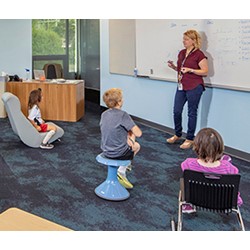
Adaptive and alternative seating, including wobble stools, floor rockers, and flexible chairs, supports students who need movement to focus. For students with sensory processing differences, the ability to move while learning is not a preference; it is a functional need.
Sensory-friendly design choices, including soft seating, muted color palettes, reduced visual clutter, and sound-absorbing materials, reduce the environmental load on students who are easily overstimulated. These choices benefit all students, but they are especially important for those with anxiety, autism spectrum disorder, or sensory processing differences.
Wide aisles and clear circulation paths ensure that students with mobility aids can navigate the space independently, which matters both practically and for their sense of autonomy.
When schools design for the students with the most acute needs, the environment tends to work better for everyone.
How does furniture selection translate these ideas into practice?
The space strategies above only work if the furniture supports them. A few practical implications for procurement and planning:
Flexibility is functional. Regulation stations, breakout areas, and peer collaboration spaces all require furniture that can be reconfigured quickly. Lightweight desks, tables on casters, and modular seating reduce the friction of layout changes and make it more likely that teachers actually use the space differently across the day.
Sensory choices are structural. Soft seating, natural materials, and varied textures are not decorative decisions. They are functional ones that support emotional regulation. When a student chooses to sit in a soft chair in a quiet corner, the furniture is doing part of the therapeutic work.
Forgotten spaces deserve attention. Areas under stairwells, in corridor corners, and in transitional spaces are places students often gravitate toward when they need to decompress. Furnishing these spaces intentionally, with appropriate seating and good sightlines for staff, improves both student experience and staff supervision. Well-designed visibility in these areas supports the kind of passive monitoring that keeps students safe without surveillance feeling punitive.
Storage is infrastructure. Sensory tools, aromatherapy supplies, and wellness materials only get used when they are organized and accessible. The right storage solutions are part of the mental health strategy, not an afterthought.
At School Outfitters, we work with school districts across the country to design and furnish spaces that reflect exactly these priorities. Whether a district is building from the ground up, renovating a wing, or adding a regulation station to an existing classroom, our team can help match the right products, layouts, and furnishings to the specific needs of their student population.
The bottom line
Student mental health is a design problem as much as it is a programmatic one. The spaces schools create, or fail to create, send a message to students about whether their emotional lives matter.
Schools that invest in thoughtful space design, from zen dens and regulation stations to makerspaces and biophilic furnishings, are not just checking a wellness box. They are building environments where students feel seen, regulated, connected, and capable.
That is not a small thing. That is the foundation of learning.
About the author
Greg Nelson is a research professional and college educator who examines the impact of the physical environment on educational outcomes. As Director of Customer and Market Research at School Outfitters, he applies his research to learning space design, product innovation, brand communication, and website development. He also teaches psychology at Sinclair Community College in Dayton, OH. Courses taught include Educational Psychology, Lifespan Development, Social Psychology, Industrial/Organizational Psychology, and Intro to Psychology.