




Take a tip from the entrepreneurs, freelancers, and telecommuters who pop into local coffee shops for inspiration outside of traditional work settings. As an inviting coffee house stirs people to productivity, school dining areas can likewise spark students' intellectual engagement. Thoughtfully furnished dining areas will attract students to eat, collaborate, study, create, socialize, or just relax.
But creating a space students want to be in is just one piece of the puzzle. School cafeterias carry a lot of responsibility beyond lunchtime.
Most school dining spaces double as event venues, testing rooms, community gathering spaces, and sometimes even emergency staging areas. That means your furniture needs to do more than look good over a meal. It needs to fold, stack, roll, and reconfigure quickly without a facilities crew on standby. Durability matters, too. With hundreds of students cycling through every day, surfaces take a beating, and replacement budgets are rarely generous.
There are also real compliance considerations. Under the 2010 ADA Standards for Accessible Design, school cafeterias must provide accessible routes, compliant table heights, and clear aisle widths — requirements that directly shape furniture selection and layout. Safe traffic flow during peak periods and proper sightlines for supervision factor in as well. Tighter budgets mean schools need furniture that lasts, and procurement processes often favor vendors who can supply at scale, deliver on time, and support installations without adding headaches.
The good news is that thoughtful furnishing choices can meet all of these needs at once. Here are five ways to do it:
What are the main cafeteria table and seating options for U.S. schools?
U.S. school cafeterias typically rely on a combination of the following:
Fixed-height and adjustable cafeteria tables — including rectangular, round, and combination bench-seat models designed for high-volume, high-durability use
Mobile and folding tables — allow rapid reconfiguration for events, testing, and emergency use
Round and pedestal tables — support collaborative seating and ADA-compliant clear-floor-space requirements
Booth and cluster seating — create defined zones and a sense of ownership for students
Lounge and soft seating — adds informal gathering options around the dining perimeter
ADA standards require that at least 5% of fixed tables in cafeterias be accessible, with knee clearance of 27 inches minimum and table tops between 28 and 34 inches above the floor. Aisle widths of 36 inches minimum — 42 inches preferred — are required along food service line
1. How can you create a variety of spaces in school cafeterias?
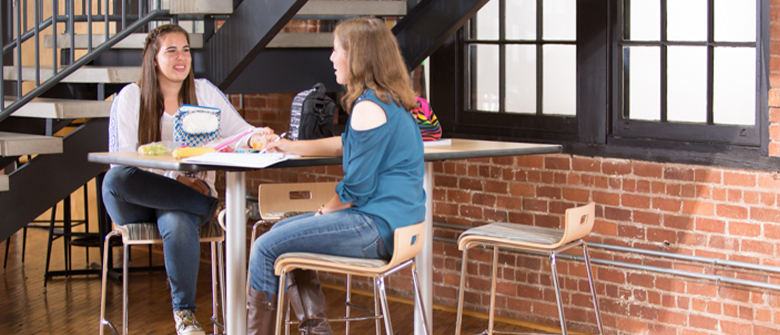
When people can claim their own areas, the sense of ownership motivates them to enter the space. Choices kindle a feeling of a personal space for focus or interaction. Vary your dining areas with combinations of seat-height and counter-height cafeteria tables, padded and structured-back seats, or chairs and stools on casters and glides. Mixing in cafeteria booth and cluster seating options gives students even more ways to find a spot that feels like their own.
2. How do power-enabled furnishings benefit students?
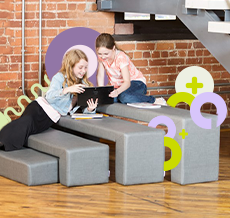
There's no quicker way to attract people to any space than to provide power for devices. Power lets people stay engaged on their laptops, tablets, or cell phones. Keep your learners charged up with a variety of outlets embedded in lounge and soft seating, built into tables, and readily available in portable power towers.
3. Why does roundtable seating support inclusion and equal participation?
Research published in the British Journal of Educational Technology found that round tables lead to higher levels of on-task participation compared to rectangular tables, particularly among younger students. Additional research on round table layouts shows that circular seating arrangements promote consensus and more equal contributions from all participants — because everyone faces each other and no seat signals greater status than another.
Browse Café and Pedestal Tables
4. What makes flexible furniture arrangements valuable for school cafeterias?
Need show choir practice space? Let students fold the tables and push them to the side. Need to accommodate three more people? Push small tables together and carry over the soft seating units. Mobile cafeteria tables, lightweight seating, and tables on wheels make dining areas most useful for the greatest number of people. Convertible and folding options from brands like Learniture, AmTab, KI, and Palmer Hamilton make reconfiguring your space quick and easy.
5. How do durable, easy-to-clean surfaces reduce long-term costs?
A high-traffic cafeteria needs furniture that holds up and stays looking good. Look for cafeteria tables with durable laminate or high-pressure surfaces that wipe down quickly between uses. Pair them with café table and chair sets
Ready to reimagine your school's dining space? Browse the full Cafeteria and Food Court collection
Need help getting started? Our veteran consultants are passionate about tailoring learning spaces to your educational goals. Call us at 1-800-260-2776 or email [email protected] to start the conversation.