

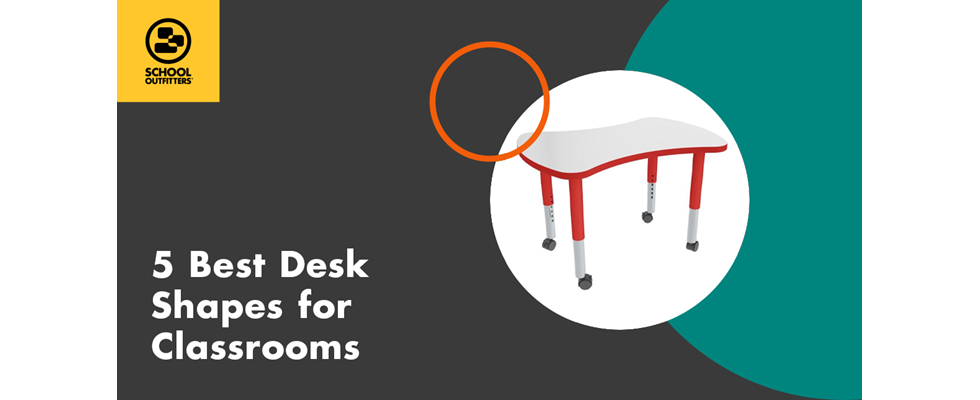
Your desk shape does more than fill a floor plan. It sets up how students move, share materials, and stay focused from bell to bell.
Start with 3 quick checks
Teaching routines: Pick the layouts you use most (independent work, pairs, small groups, stations), then choose shapes that match
Room flow: Measure the full footprint, add chair space, then confirm clear walkways to doors, storage, and teaching areas
Real desktop space: Test the surface with everyday items (device, notebook, workbook), not a photo
Quick visual key
Rectangular: rectangle
Trapezoid: trapezoid
Triangular: triangle
Boomerang: curved edge that hugs a group
Bow tie: pinched center that brings students closer
1. Rectangular desks for straightforward layouts
Best for
Rectangular desks support day-to-day seating plans like rows, pairs, and simple table groups. The familiar footprint also makes it easier to swap layouts when a lesson changes midweek.
Why it works
Easy alignment: Straight edges line up fast for rows and pairs
Flexible grouping: Small groups come together without awkward gaps
Quick layout check
Measure the full desk footprint, plus chair space behind each seat
Confirm the usable work surface, not just the overall dimensions
School Outfitters recommends checking both the overall size and the actual work surface before finalizing a model. (schooloutfitters.com)
2. Trapezoid desks for flexible grouping
Best for
Trapezoid desks fit classrooms that shift between independent practice and small-group learning. Many models join into clusters, so one room supports multiple lesson types without extra furniture.
Why it works
Natural clusters: Group shapes feel intentional, not improvised
Quick resets: Groups break apart into individual spaces without hauling desks
Quick layout check
Ask for the footprint of the full cluster you plan to use
Mark it on the floor with chairs included, then walk the pathways
School Outfitters calls out trapezoid desks as a shape that fits together for collaborative arrangements. (schooloutfitters.com)
3. Triangular desks for collaborative stations
Best for
Triangular desks work well for stations, project pods, and rooms that build in student-to-student talk. The shape can create tidy groups while still giving each student a defined work zone.
Why it works
Strong station setups: Pods form a clear home base for materials
Group visibility: Students can face in without twisting in a chair
Quick layout check
Test the narrow points with real materials to confirm enough writing space
Lay out multiple desks in the recommended configuration before you buy
School Outfitters lists triangle shapes among desks designed to fit together for collaboration. (schooloutfitters.com)
4. Boomerang desks for frequent collaboration
Best for
Boomerang desks suit classrooms that use small groups daily. A curved edge can pull a group closer while keeping personal space clear, which helps routines stay calm and predictable.
Why it works
Group-ready shape: Desks form clusters without large gaps
Defined workspace: Each student still has a personal surface
Quick layout check
Measure the widest span and full depth, not just the center writing area
Verify compatibility if you plan to mix models within one classroom
School Outfitters includes boomerang desks among shapes that support collaborative group arrangements. (schooloutfitters.com)
5. Bow tie desks for shared problem-solving
Best for
Bow tie desks fit lessons that move from independent thinking to quick partner sharing. The pinched center can bring students closer for discussion without turning every activity into a full group reset.
Why it works
Fast collaboration: Partner work feels natural
Clear transitions: Students keep a defined space when the task changes
Quick layout check
Test the center area with everyday materials to confirm comfortable writing space
Map the full footprint, then add chairs before finalizing quantities
School Outfitters lists bow tie shapes among desks that join into collaborative workspaces. (schooloutfitters.com)
Q&A
Question: What desk shape supports both independent work and quick group work?
Short answer: A shape designed to fit together, such as trapezoid, triangular, boomerang, or bow tie. Ask for the exact configuration for the model, then test the full cluster with chairs included.
Question: What should a test layout include before a bulk order?
Short answer: Full desk footprint, chair space at every seat, everyday materials on the desktop, and real walkways to doors, storage, and teaching areas.
Question: What surface detail matters most when comparing desks?
Short answer: Usable work surface, not only the overall dimensions. A quick test with a device, a notebook, and an open workbook shows what truly fits.
Question: What helps shaped desks fit together the way the photo shows?
Short answer: Matching models and the manufacturer’s layout plan. Similar shapes from different lines may not align, even when they look close.
Question: What is the simplest way to compare shapes without a sample?
Short answer: Floor tape or paper templates. Map the outline, add chair space, and try 2 everyday layouts before you commit.